Capability
What can it do? The empirical question, answered against your own data rather than against a demo. This is the part that improves on its own, and the only one of the three a vendor can settle for you.
Speaking
Leading business in the GenAI and agentic era. Organisations are not short of AI capability. They are short of a way to decide what to let it do.
For boards and executive teams, MBA and executive-education cohorts, conference main stages, and the architects and engineering leaders who have to make it real.
Delivered September 2026 · Amsterdam Business School · 2 hours · 35 min unscripted Q&A
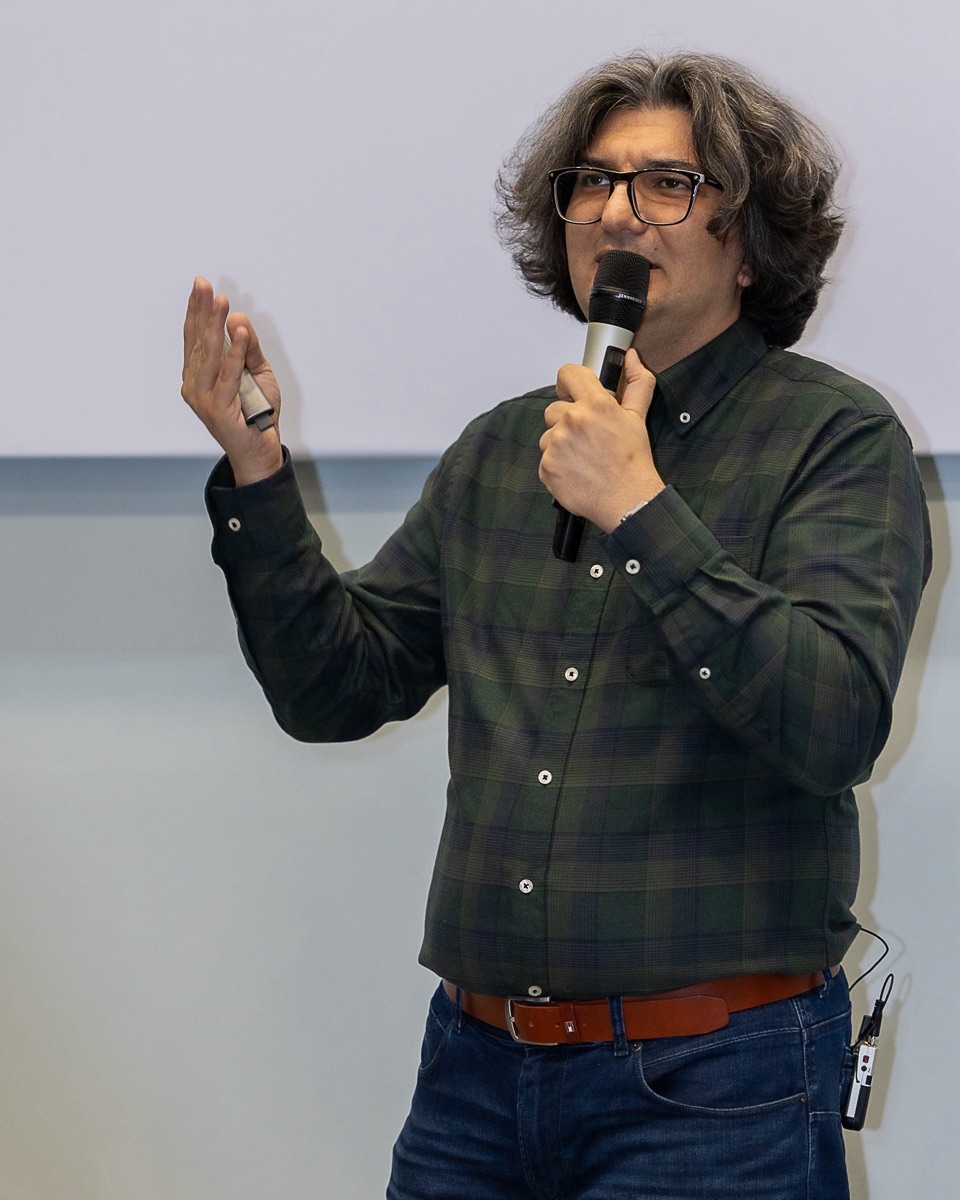
The same system can draft a reply, send it, or commit the organisation to a refund. The technology does not change between those three. The permission changes, and so does the consequence. Most organisations have argued about the technology and never decided the permission.
This talk gives a room a shared way to make that decision: what a system can do, what it may do here, and who answers when it is wrong. It runs from the plain mechanics of how we arrived at agents, through what actually held up when these systems went into production in a regulated bank, to the three decisions a sponsor cannot delegate.
What can it do? The empirical question, answered against your own data rather than against a demo. This is the part that improves on its own, and the only one of the three a vendor can settle for you.
What may it do here? Capability is general; authority is local. The same model that may draft in one process must not send in another. Somebody chooses this. It is not a property of the technology.
Who answers for the outcome? When a wrong answer has already left the building, the name on it is a human one. This is the question that never moves to the machine.
The full framework, with its failure modes →
The delegation ladder
Read→Draft→Send→Commit
Four rungs of autonomy, not a ranking of sophistication. Most failures are a system placed one rung above the authority it was actually assessed for.
Three questions, in fact, and the discipline of noticing which one a confident answer has quietly skipped. A powerful model settles the first. It does not settle the other two.
A proof of concept shows the technology works. Production shows that quality is far harder than anyone expects, especially for retrieval, where the state of your source data quietly determines the quality of every answer.
Choose who to serve first and prove the value where the risk is lowest. Fund the foundations early, because everything built on them waits. Name what stays human before the system ships. None of the three is a technical decision.
How it runs in the room
It opens with a live vote. The room commits to a position on what it would let a system do on its own behalf, before anyone has heard an argument. It closes on the same vote, and watching the room's own answer move is the point.
As delivered: two hours, of which thirty-five minutes was unscripted questions from the floor. It also runs at 45, 60 and 90 minutes. The model stays; the depth and the number of worked examples change.
What the room wanted next
Attendees wrote afterwards asking what a follow-up session should cover. The requests clustered, and the clusters are worth knowing if you are programming this for your own audience. They are the questions a mixed business and technical room arrives with, and the ones an hour on stage does not finish.
Those five clusters are close to the four module programme I run with architecture and leadership teams. If your audience arrives with the same questions, that is usually the right next session rather than a second talk. See the programme →
My own account, drawn from written follow-ups after the lecture. Summarised by theme and not attributed, because the people who wrote have not been asked whether they may be quoted.
Drawn from two years of taking generative AI use cases into production in a regulated, financial-grade European environment: retrieval-augmented generation, document intelligence, summarisation, assistants, and the responsible-AI controls around them.
Most organisations spent two years proving that generative AI works. Very few crossed the line into production. The reasons given were usually regulation, security, and uncertainty. All three were real. But waiting was never the safe option it appeared to be. It was simply a risk that didn't show up on anyone's slide.
A narrower, more technical session on what it takes to cross that line: how to choose a first production use case, how to sequence risk so you are not testing everything at once, and what production teaches you that a proof of concept structurally cannot. Built for engineering and architecture audiences rather than mixed rooms.
Where agentic patterns break in production, and the architectural separation that keeps them traceable and auditable.
What the transparency obligations require of teams actually shipping, and where organisations believe they are covered and are not.
Responsible AI as an engineering practice rather than a review gate.
Talks are tailored to the audience. Formats: conference keynote, breakout session, executive briefing, panel, or internal leadership session.
Alireza Chegini is an enterprise AI architect based in The Hague, and Domain Architect for Enterprise AI and Governance at Rabobank, where he has spent two years shaping the bank's first generative AI platform and the reusable building blocks behind it. Over 25 years he has moved from software engineer to enterprise architect, leading large-scale initiatives in regulated, financial-grade environments where mistakes are expensive and discretion is not optional.
He designs and ships production-grade generative and agentic AI in those settings: RAG, agentic systems, AI platforms, and the responsible-AI and governance layers around them. His work is the unglamorous part of the field: what will work, what will fail, and what it will cost, established before it becomes expensive to find out.
He is also the founder of Coding As Creating, an AI-native studio building products and open, freely available AI initiatives.
Interested in having me speak?
Tell me about the audience, the date and format, and the budget you have for the slot. I will come back with a tailored outline.
I take a limited number of speaking engagements each year, and most are paid. I do make exceptions for university and non-profit audiences where the fit is right, so ask either way.